The Tomb Of Saint Carlo Acutis
A guide to visiting Carlo's resting place at the Sanctuary of the Spogliazione in Assisi, a space where the lives of St Francis and Carlo meet, and where thousands of pilgrims come to pray each year.
Where Is Carlo's Tomb?
Carlo's mortal remains rest in the Sanctuary of the Spogliazione (Sanctuary of the Stripping) inside the Church of Santa Maria Maggiore, just off Piazza del Vescovado in Assisi. This is the very place traditionally associated with St Francis's dramatic renunciation of his wealth, when he stripped off his fine clothes to follow Christ in poverty.
On 6 April 2019, Carlo's body was brought here in procession and placed in a permanent tomb in the right aisle of the sanctuary. Since then, the church has become one of the key pilgrimage sites in Assisi, alongside the basilicas of St Francis and St Clare, especially for young people who recognise in Carlo a saint of their own generation.
Conception And Design Of The Tomb
The tomb is not just a grave but a liturgical space for contemplation. The brief given to the artist was sensitive and demanding: it was not only to house Carlo's body, but to create a place where visitors could "breathe" and ponder the mystery of a teenager who discovered the beauty of holiness in a very short life.
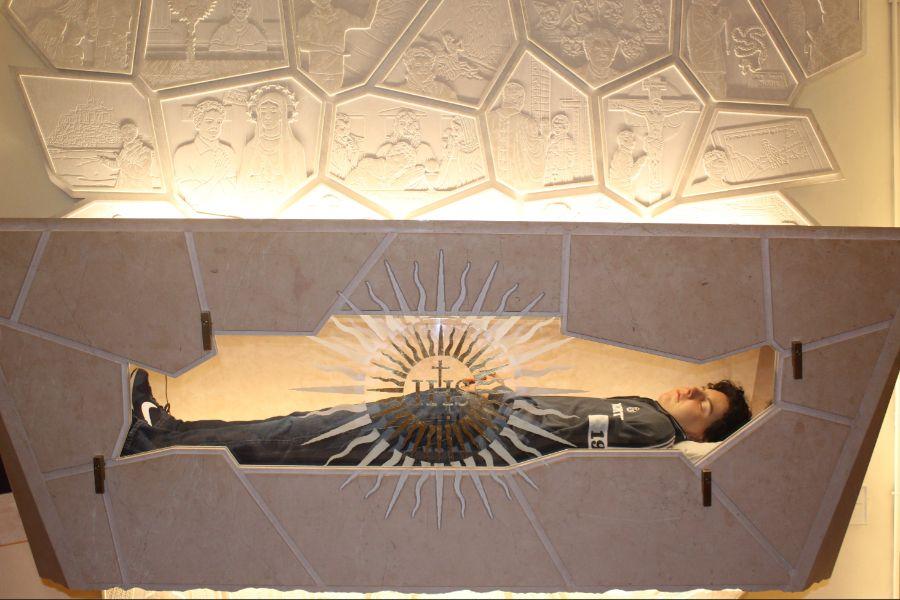
The sepulchral monument was designed by sculptor Eraldo Marini. It resembles a great stone sarcophagus that has been gently torn open and lifted from the floor. The trapezoidal form appears to peel away from the ground, giving an impression of upward movement: as if Carlo's body were being drawn towards heaven. Despite the weight of the material, the whole structure feels strangely light and suspended.
The tomb is carved from pink Assisi stone, the same warm material used in much of the church's floor and fabric. This choice anchors Carlo's resting place within the architectural language of Assisi itself: the young saint's body lies in the same stone that has supported centuries of pilgrims and friars.
Along the wall behind the sarcophagus stretches a large mosaic-like relief made up of many irregular stone tiles. Each panel carries bas-relief scenes from Carlo's life: his family, his friends, his love for the poor, his fascination with computers, and his devotion to the Eucharist. The drawings for these panels were created by illustrator Mario Cossu and then translated into stone. A soft light rises from behind the tomb, making the tiles seem to move and come alive, as if Carlo's story were still unfolding.
The Eucharist At The Heart Of The Tomb
At the centre of the glass window through which pilgrims see Carlo lies a radiant symbol of the Eucharist. The letters IHS: an ancient Christogram, blaze like a sunburst over his body. This motif was chosen deliberately: for Carlo, the Eucharist was "my highway to heaven", the daily meeting with Jesus that shaped every part of his life.
The stone "tear" of the sarcophagus, the rising light, and the Eucharistic emblem all work together to communicate the same message: Carlo's body rests in the earth, but his life is caught up in the mystery of Christ. The tomb is meant to lift the gaze from grief to hope.
Carlo's Body: A Teenager Close To Us
Through the glass front, pilgrims see Carlo lying in the casual clothes he wore in life: trainers, jeans, and a sports-style jacket. His face and hands are presented with a wax mask and gloves, a traditional practice used for saints whose remains are no longer fully intact, so that the faithful can venerate them with dignity. What strikes most visitors is how ordinary he looks, like any teenager you might see on a bus or at a computer.
This choice was intentional. As the rector of the sanctuary has said, the Church wanted the world to see that holiness is not distant or reserved for a few. In Carlo, a boy of the internet age, God shows that even a normal young person, who loved football, video games, and coding, can become a great saint.
Francis And Carlo: Singers Of Life And Goodness
The Sanctuary of the Spogliazione is deeply marked by St Francis's renunciation. Here, the young Francis took off everything that tied him to his old life and entrusted himself completely to God. Today, Carlo rests in the same place, and Bishop Domenico Sorrentino loves to speak of them together as "Francis and Carlo, singers of life and goodness".
Francis's stripping was an outward gesture that expressed a radical inner choice. Carlo's "stripping" was quieter, lived out in the ordinary: he chose God over ego, charity over indifference, the Mass over comfort, and truth over compromise. His simple motto, "Not I, but God", mirrors Francis's own decision to let Christ be the centre of everything.
Standing before the tomb, pilgrims are invited into the same path: not to flee the modern world, but to fill it with the flavour of the Gospel, just as Francis and Carlo did in their very different centuries.
A Living Place Of Pilgrimage
Since Carlo's body was placed here in 2019, the sanctuary has seen a steady and at times overwhelming flow of pilgrims from all over the world. School groups, youth movements, scouting groups, families, priests and religious, many plan their entire visit to Assisi around a moment of prayer at this tomb.
During the period of the beatification celebrations, Carlo's body was displayed in an open glass coffin for several weeks, drawing thousands of visitors each day. Later, the tomb was briefly closed with a stone panel; in 2022, the panel was removed so that the faithful could once again see Carlo permanently and pray in front of him.
For many, the encounter is deeply personal: they bring their worries about children, technology, addiction, illness, or vocation, and entrust them to Carlo, asking him to help them make the same wholehearted choice for God that he made.
How To Visit Carlo's Tomb
The Sanctuary of the Spogliazione is just a short walk from Assisi's main square and from the Cathedral of San Rufino. The town is built on a hillside, so expect some slopes and stone streets, comfortable shoes are a good idea.
- • Enter the Church of Santa Maria Maggiore and follow the signs to Carlo Acutis' tomb in the right aisle.
- • Take a moment to sit or kneel in silence; many pilgrims like to pray the Rosary or a decade in front of the tomb.
- • If Mass is being celebrated, wait until after the liturgy to approach the tomb closely, out of respect for the celebration.
- • Photography is usually permitted, but avoid flash and never during Mass or in a way that disturbs others.
If you are part of a group, it can be helpful to arrange a short catechesis or moment of sharing beforehand, so that young people in particular understand who Carlo is and why this spot has become so important for the Church.